Last updated 2026-08-18
TL;DR
Vermont issues no state ICF contractor license, so there's nothing to renew at the state level. You register a business, carry workers' comp if you have employees, and pull permits town by town. Electrical and plumbing need separate state licenses. Your real annual cycle is insurance renewals and an LLC annual report, not a contractor card.
Do you need a license to do ICF contracting in Vermont?
No, not a dedicated ICF license. Vermont runs no general contractor licensing board and issues no statewide contractor's license that covers ICF construction [1]. That puts the state in a small minority, and it throws people coming from Florida or California, where you can't legally swing a hammer without a board-issued card.
What Vermont does want is business registration. If you operate as anything other than a sole proprietor under your own legal name, register with the Vermont Secretary of State. LLCs and corporations file articles of organization or incorporation there [2]. Sole proprietors often still register a trade name so they can open a business bank account and sign contracts under it.
There's a tax piece too. Contractors who hire employees or collect sales tax on materials register with the Vermont Department of Taxes [3]. If you do design-build work with taxable services or materials, check the specifics with a Vermont tax professional, because the line between taxable and non-taxable construction work moves depending on how the contract is written.
Some trades that touch nearly every ICF project do require state licenses. Electrical work requires a Vermont Electrician's License through the Department of Public Safety [4]. Plumbing requires a Plumber's License through the same department. As an ICF general contractor, you sub those trades to licensed folks or hold the licenses yourself. That shapes your staffing model, so plan for it early.
What about workers' comp and liability insurance requirements?
This is where Vermont gets strict. It's the functional gate that stands in for a license, even though nobody calls it that.
Vermont law requires nearly all employers, including construction contractors with even one employee, to carry workers' compensation insurance [5]. The threshold is low. Hire one part-time laborer to help stack forms and you're almost certainly covered by the mandate. Sole proprietors with zero employees can often exempt themselves, but that exemption vanishes the moment you add help.
General liability isn't mandated by state statute the way workers' comp is. Every general contractor and project owner worth working with will still require it by contract. Most ICF projects pull in lenders or architects who demand certificates of insurance before work starts. A general liability policy for a small Vermont ICF contractor usually runs $1,500 to $4,000 a year depending on payroll, project scope, and claims history. Those figures come from broker quotes, not any fixed schedule, so treat them as a starting range.
So the real renewal cycle for a Vermont ICF contractor is an insurance renewal cycle. Workers' comp and general liability policies renew annually. Your workers' comp carrier audits actual payroll at the end of each policy year and adjusts your premium up or down. Keep clean payroll records all year and the audit stops being a surprise.
For how neighboring states handle this, see ICF contractor renewal in Connecticut and the comparison further down.
How much does ICF contracting cost to set up and operate in Vermont?
Cost spreads across several buckets, and none carry a single official price tag. Here's the honest breakdown of what you'd actually spend.
Business registration with the Vermont Secretary of State costs $125 for an LLC filing under the current fee schedule [2]. LLC annual reports cost $35. Corporations pay different amounts, and sole proprietors filing a trade name pay less. Small numbers all around.
Workers' comp is the big variable. Vermont uses classification codes tied to NCCI (National Council on Compensation Insurance) rates. Carpentry and general construction run higher per $100 of payroll than office work, roughly $8 to $20 per $100 of payroll for construction classes, though your specific class code and experience modification factor swing the number hard [6]. A crew running $300,000 in annual payroll could easily land between $25,000 and $45,000 in workers' comp premium. Confirm current rates with a Vermont broker.
Local building permits are town-controlled here. The state has no unified permit fee schedule. A small residential ICF project might carry a few hundred dollars in a rural town. A larger commercial job in Burlington or Montpelier could run several thousand. Towns calculate fees off project valuation, square footage, or a flat schedule, so you check each municipality directly.
Electrical and plumbing permits are separate and go through the Department of Public Safety, not the town, for most project types [4].
| Cost Item | Typical Range | Notes |
|---|---|---|
| LLC formation (SOS) | $125 | One-time [2] |
| LLC annual report | $35/year | Ongoing |
| Workers' comp insurance | $8-$20 per $100 payroll | NCCI class-rate dependent [6] |
| General liability insurance | $1,500-$4,000/year | Broker quote; varies by scope |
| Local building permit | $200-$5,000+ | Town-set, project-dependent |
| Electrical/plumbing permits | Varies | Through Dept. of Public Safety [4] |
How long does the setup and renewal process take in Vermont?
Depends which piece you mean. Registration is quick, insurance is slower, and permits swing wildly by town.
Business registration with the Secretary of State is fast. Online LLC filings usually process within one to five business days [2]. Paper filings take longer. There's no waiting period before you can start bidding once you're registered.
Insurance binds slower than people expect when you're new to the market. Getting quotes from three to five carriers, handing over payroll estimates and loss runs, and actually binding coverage can take one to three weeks if you're organized. Any prior claims or gaps in coverage draw more questions from underwriters, and it stretches out.
Local permits can trigger Act 250, Vermont's land use and development control law, for projects above certain size and scope thresholds [7]. Act 250 review adds time, sometimes months, to larger projects. Most single-family ICF homes won't trigger it unless they sit in sensitive areas or clear the thresholds. Check Act 250 applicability before you promise a client a timeline.
Town-level building permit review runs from a few days in small towns with part-time zoning administrators to several weeks in larger towns with full planning departments and busy construction markets. Burlington's review has more layers than a small Northeast Kingdom town's.
Getting an actual state trade license (electrical, plumbing) is its own process with exam and experience requirements, and it can take months or longer depending on your starting credentials. If you plan to self-perform electrical or plumbing on your ICF jobs, budget serious time for that path.
What is the annual renewal cycle for a Vermont ICF contractor?
Vermont has no contractor license to renew, so your real annual checklist looks like this. Five things, none of them a state contractor card.
First, file your LLC or corporation annual report with the Secretary of State by the due date. Confirm the exact date for your entity type on the SOS website [2]. Miss the annual report and your entity slides into bad standing, then eventually administrative dissolution. That's a real problem mid-project.
Second, renew your workers' comp policy before it lapses. Your carrier sends renewal paperwork and asks for updated payroll estimates. The end-of-year audit reconciles estimated against actual payroll and generates a credit or an additional bill. Clean payroll records keep the audit boring, which is what you want.
Third, renew general liability. Also annual for most contractors. Shop it every two or three years so your limits and coverage track your current work. A contractor doing $2 million in annual revenue needs different limits than one doing $200,000.
Fourth, if you or your crew hold state trade licenses (electrical, plumbing), track those renewal dates separately. Vermont electrician licenses run their own cycle through the Department of Public Safety [4].
Fifth, check whether any town where you work requires local contractor registration. A few Vermont towns have added local requirements, though it's uncommon. Confirm directly with each town's zoning or building office.
Nobody sends you a master renewal reminder in Vermont. You build the calendar yourself.
Do Vermont ICF contractors need OSHA training or certifications?
Vermont runs its own OSHA-approved state plan, the Vermont Occupational Safety and Health Administration (VOSHA), under the Department of Labor [8]. VOSHA adopts federal OSHA standards and has jurisdiction over public-sector employers. Private-sector employers in Vermont fall under federal OSHA directly.
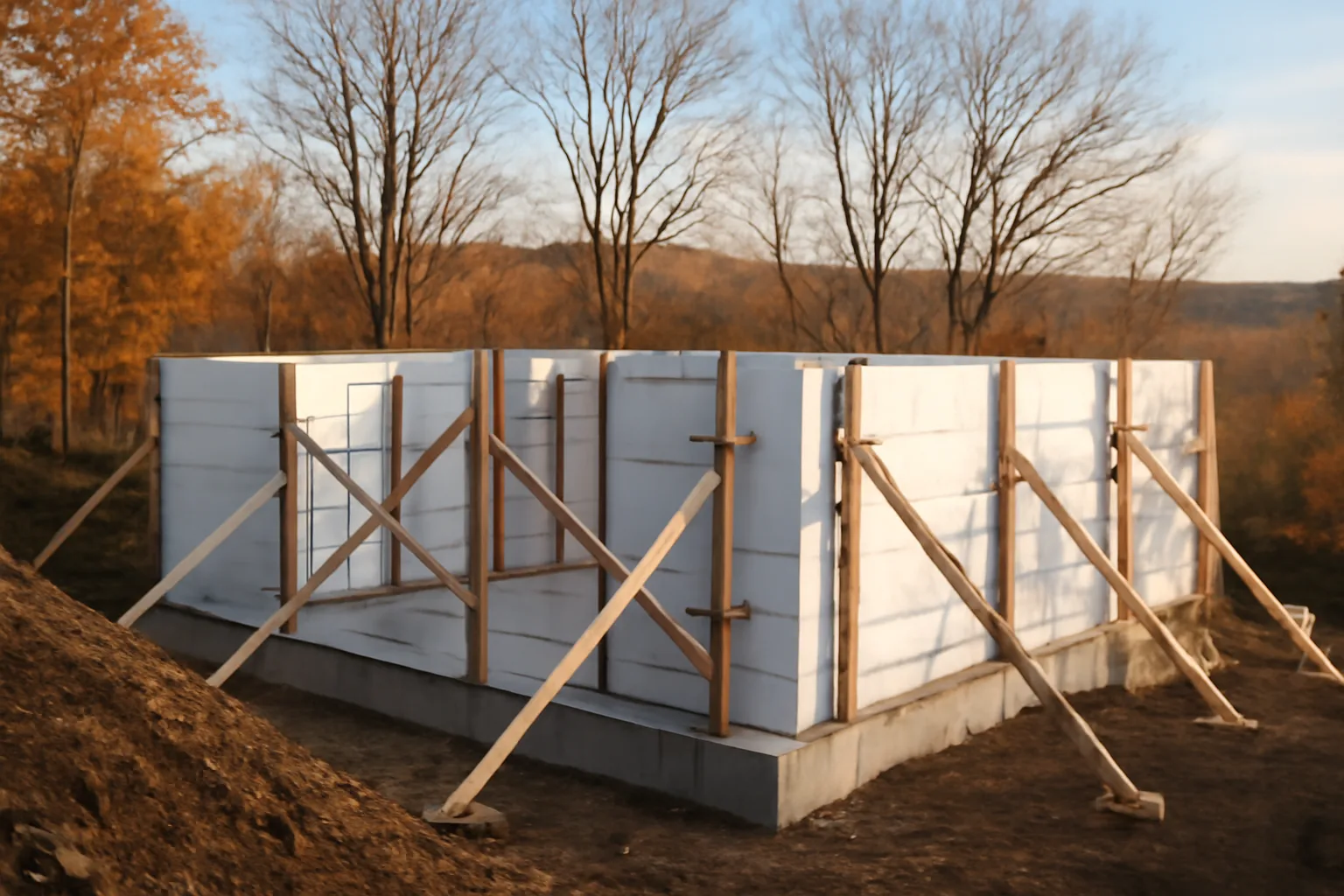
For ICF work, the standards that matter cover fall protection (29 CFR 1926.502), scaffolding, and concrete and masonry construction (29 CFR 1926 Subpart Q) [9]. ICF walls get tall fast, and bracing failure is the number-one serious hazard on an ICF pour. OSHA's concrete and masonry standard speaks directly to formwork and shoring.
OSHA 10-hour and 30-hour construction training isn't federally required for all workers, but plenty of general contractors and project owners require it by contract. Some Vermont public projects and union agreements set OSHA 10 as a baseline. Train your crew regardless of the mandate. An OSHA 30 for the lead person on site is a reasonable investment.
Vermont has no ICF-specific certification requirement. Major ICF manufacturers do run installer training programs, and some architects and structural engineers prefer or specify installers who hold manufacturer credentials. That's a market expectation more than a legal one, but it decides whether you win certain jobs.
How does Vermont's building code affect ICF projects?
Vermont adopted the 2015 International Building Code and 2015 International Residential Code as its base codes, with state-specific amendments, through the Vermont Fire and Building Safety Code [10]. The energy code matters here too: the state adopted the 2015 IECC with amendments, and ICF walls hit those numbers easily thanks to the continuous insulation they carry.
Vermont's residential energy code is genuinely demanding by national standards. Burlington sees around 8,000 heating degree days a year, which lands most of the state in a very cold climate zone (Zone 6) [10]. ICF's thermal mass and continuous insulation make wall compliance simpler than stick framing does, and that's a real selling point for clients.
Inspections happen locally for most residential and light commercial work. The local building inspector, often a hired third-party inspector in smaller towns, checks footings, foundation walls, framing, insulation, and rough-in systems before you close in. On ICF work, the inspector usually wants to see the wall bracing and form setup before the pour. Schedule that inspection before you pour, never after.
Act 250 projects run a separate state-level review that can pull in the Agency of Natural Resources, the Agency of Transportation, and regional planning commissions [7]. ICF contractors on those jobs should expect to hand over material specifications and coordinate with the permit application team.
What do Vermont ICF contractors actually need before bidding a job?
Here's the practical list before you hand over a signed contract. Get these in a folder and you can bid with a straight face.
Business entity registered with the Vermont Secretary of State and in good standing. Workers' comp bound with a certificate ready. General liability bound with a certificate ready. Vermont tax registration done if you have employees or taxable transactions. A clear read on which trade licenses the project needs and whether you hold them or have licensed subs lined up.
On the ICF side, keep the manufacturer's technical documentation for the exact form system you're using, because inspectors and engineers sometimes ask for it. Many ICF systems carry ICC Evaluation Service (ICC-ES) reports that show code compliance, and having the report number handy saves time on permit submissions [10].
If your client is financing through a lender, the lender's inspector will also want your insurance and may want a copy of your contractor agreement. Get fast at producing those.
This is where manufacturer training earns its keep. If you're newer to ICF, a structured installer program from a manufacturer, or a resource like ICFPath's one-time certification and takeoff kit at /start, gives you documentation that you formally learned the system. That matters when a skeptical building official or architect asks what your ICF credentials are. It's not a license, but it's something real to put in front of them.
How does Vermont compare to nearby states for contractor requirements?
Vermont is one of the least license-restrictive states in New England for general contractors. That's an advantage and a trap at the same time.
The advantage: low barrier to entry, no exam, no experience hours to log for a general contractor license. You can start bidding ICF work soon after your business is set up.
The trap: because anyone can hang a shingle, Vermont clients sometimes can't tell an experienced ICF contractor from a green one. Your differentiation comes from insurance, references, and any formal training documentation you carry, not from a board-issued credential.
Connecticut takes the opposite approach, requiring a Home Improvement Contractor registration for residential work plus a separate New Home Construction Contractor registration. See ICF contractor renewal in Connecticut for that renewal cycle and fee structure. New Hampshire requires no general contractor license for most work, much like Vermont. Massachusetts requires a Home Improvement Contractor registration for residential remodeling.
Vermont is small and hugs New Hampshire, New York, and Massachusetts, so many contractors work across state lines. If you do, learn each state's requirements separately. Working without the right registration or insurance in a neighboring state is real legal exposure, not a technicality.
For the wider range of state approaches, see ICF contractor renewal in Colorado and ICF contractor renewal in Idaho.
What's the Vermont home improvement contractor landscape for ICF additions and renovations?
Vermont has no home improvement contractor (HIC) registration separate from general business registration. Some states, Massachusetts among them, run a mandatory HIC program with its own license and renewal. Vermont doesn't.
So a Vermont homeowner hiring an ICF contractor for a renovation or addition gets less formal protection from state licensing than a homeowner in some neighboring states. The protection that exists comes from the workers' comp mandate, the building permit and inspection process, and civil court as the backstop.
For you as the contractor, that means operating without the implied credibility a state registration number carries in other markets. Lead with your insurance, the permits you've pulled, your manufacturer training, and references. That work matters more in Vermont than in states where a license number does some of it for you.
For ICF-specific additions, like pouring an ICF basement under an existing structure or tying an ICF addition onto a wood-frame house, the structural connection between new and old needs careful detailing. The building inspector will look hard at it, and your structural engineer's drawings have to address it. This is not a spot to wing it.
Where to confirm current Vermont requirements before you start
Vermont's rules change. The Secretary of State updates filing fees. The legislature amends the workers' comp statute. Towns adopt new local requirements. This article reflects the framework as of mid-2026, so verify the current specifics from these primary sources before you act on any of it.
Vermont Secretary of State, Corporations Division: business registration, annual report requirements, and fees [2].
Vermont Department of Labor: workers' comp requirements and VOSHA information [8].
Vermont Department of Public Safety, Division of Fire Safety: electrical and plumbing license requirements and permit processes [4].
Vermont Department of Taxes: business tax registration [3].
Your town's zoning and building office: local permit fees, inspection requirements, and any local contractor registration. This is a phone call, not a website search.
Act 250 District Coordinators: if your project might trigger Act 250, the Natural Resources Board has regional coordinators who give preliminary determinations [7].
ICFPath is an independent publisher. We're not a law firm and not a licensing service. Use these sources directly, and for anything with real legal or financial weight, talk to a Vermont attorney or accountant.
Frequently asked questions
Do you need a license for ICF contracting in Vermont?
No state-issued ICF contractor license exists in Vermont. The state does not license general contractors. You need a registered business entity, workers' comp insurance if you have employees, and local building permits for each project. Electrical and plumbing work on your projects requires separate state-issued trade licenses held by you or your subcontractors.
How much does it cost to set up as an ICF contractor in Vermont?
LLC formation costs $125 with the Secretary of State, plus $35 per year for the annual report. Workers' comp insurance is the biggest cost: roughly $8 to $20 per $100 of payroll for construction classifications, which can reach tens of thousands annually for a small crew. General liability runs $1,500 to $4,000 per year for a small contractor. Local building permit fees vary by town and project size.
How long does it take to start operating as an ICF contractor in Vermont?
Business registration online takes one to five business days. Binding insurance can take one to three weeks if you're new to the market. Local building permits vary widely by town, from days to several weeks. The process has no mandatory waiting period once your entity is registered and insurance is bound. Act 250 review, if triggered, can add months.
Is there a Vermont contractor license renewal fee?
There's no contractor license to renew in Vermont. The recurring costs are the $35 LLC annual report fee, annual workers' comp and liability insurance premiums, and any local permit fees per project. Trade license renewals (electrical, plumbing) have their own fee schedules through the Vermont Department of Public Safety. Confirm current amounts directly with that department.
Does Vermont require workers' comp insurance for ICF contractors?
Yes. Vermont law requires workers' compensation coverage for virtually all employers with even one employee, including construction contractors. Sole proprietors with no employees may exempt themselves, but that exemption ends the moment you add help. The Vermont Department of Labor administers the requirement. Operating without required coverage exposes you to stop-work orders and penalties.
Do Vermont towns require a local contractor license or registration?
Most Vermont towns do not require a separate local contractor registration beyond the state business registration and building permits. A small number of towns have added local requirements. You need to confirm directly with the zoning or building office in each municipality where you plan to work. There is no statewide database of town-specific contractor requirements.
Does Act 250 affect ICF contractors in Vermont?
Act 250 is Vermont's land use and development control law. It applies to projects above certain size thresholds or in certain areas, and adds a state-level review layer on top of local permits. Most single-family ICF homes won't trigger Act 250, but larger commercial or subdivision projects might. The Natural Resources Board has regional coordinators who can give you a preliminary determination before you commit to a project timeline.
What building code does Vermont use for ICF construction?
Vermont's base building code is the 2015 International Building Code and 2015 International Residential Code, with state amendments, through the Vermont Fire and Building Safety Code. Vermont is mostly in IECC Climate Zone 6, which has demanding energy requirements. ICF walls typically meet or exceed wall assembly requirements more easily than stick framing in Vermont's cold climate.
Does Vermont require OSHA training for ICF construction workers?
Federal OSHA covers private-sector employers in Vermont. OSHA 10 or 30 training isn't universally mandated for all workers, but many project owners and general contracts require it. Concrete and masonry construction standards under 29 CFR 1926 Subpart Q apply to ICF pours. Having your crew OSHA-10 trained and your lead person OSHA-30 trained is a reasonable baseline regardless of any formal requirement.
Can an out-of-state ICF contractor work in Vermont?
Yes, but you need to register as a foreign entity with the Vermont Secretary of State if you're doing business in Vermont as an LLC or corporation formed in another state. You also need Vermont workers' comp coverage for Vermont employees. Your existing general liability policy may extend to Vermont work, but confirm with your broker. Check if your state of formation's contractor license, if any, carries over or is irrelevant here.
What trade licenses do Vermont ICF contractors need for electrical and plumbing work?
Vermont requires electricians to hold a state Electrician's License and plumbers to hold a Plumber's License, both administered through the Vermont Department of Public Safety, Division of Fire Safety. These are separate from any general contractor status. If your ICF projects include electrical and plumbing work, you need licensed subcontractors or must hold those licenses yourself.
How does Vermont's contractor environment compare to states with formal licensing?
Vermont is one of the least restrictive states for general contractor entry. States like Florida, California, and Connecticut have board-issued licenses with exams, experience requirements, and renewal fees. Vermont has none of that for general contractors. The tradeoff is that clients have fewer state-provided credentialing signals to rely on, so your insurance certificates, permit history, and any manufacturer training documentation matter more in Vermont.
Do ICF manufacturers require Vermont-specific certifications?
No major ICF manufacturer requires a Vermont-specific certification. Manufacturer installer training programs are voluntary from a legal standpoint, though some architects and structural engineers prefer contractors with documented manufacturer training. ICC Evaluation Service reports for specific ICF systems are useful for permit submissions and can save time when a building official asks for code compliance documentation.
Sources
- Vermont Secretary of State, Business Registration Overview: Vermont does not operate a general contractor licensing board at the state level
- Vermont Secretary of State, Domestic LLC Filing Fees and Annual Reports: LLC formation costs $125; annual reports cost $35 per year for Vermont LLCs
- Vermont Department of Taxes, Business Registration: Vermont requires contractors with employees or taxable transactions to register with the Department of Taxes
- Vermont Department of Public Safety, Division of Fire Safety, Electrician Licensing: Vermont requires a state Electrician's License for electrical work, issued through the Department of Public Safety
- Vermont Department of Labor, Workers' Compensation Overview: Vermont law requires workers' compensation insurance for employers with one or more employees, including construction contractors
- National Council on Compensation Insurance (NCCI): Workers' comp premiums are set by classification code rates per $100 of payroll, with construction classes running higher than office classes
- Vermont Natural Resources Board, Act 250 Program: Vermont Act 250 applies to development projects above certain size thresholds and adds state-level land use review on top of local permits
- Vermont Department of Labor, Vermont Occupational Safety and Health (VOSHA): Vermont operates VOSHA as an OSHA-approved state plan covering public-sector employers; private-sector employers fall under federal OSHA
- U.S. Occupational Safety and Health Administration, 29 CFR 1926.700, Concrete and Masonry Construction: OSHA's concrete and masonry construction standard (29 CFR 1926 Subpart Q) covers formwork, shoring, and bracing requirements applicable to ICF construction
- Vermont Department of Public Safety, Vermont Fire and Building Safety Code: Vermont adopted the 2015 International Building Code and 2015 International Residential Code as its base codes with state amendments; most of Vermont is in IECC Climate Zone 6